

<solver>
  ...
  <scoreDirectorFactory>
    ...
  </scoreDirectorFactory>

  <!-- No longer required to configure <constructionHeuristic> and <localSearch> -->
</solver>
Release Notes 6.3
We are happy to announce a 6.3 Final release of OptaPlanner. OptaPlanner is a lightweight, embeddable planning engine written in Java™ to solve AI constraint optimization problems efficiently. Use cases include Vehicle Routing, Employee Rostering, Maintenance Scheduling, Task Assignment, School Timetabling, Cloud Optimization, Conference Scheduling and many more.
Status of OptaPlanner
- Stable: Lots of unit, integration and stress tests
- Reliable: Used across the world in production
- Scalable: To billions of constraint matches with minimal RAM and CPU time
- Documented: Read the detailed reference manual and the many examples
- Open Source: Apache License 2.0
Note for Red Hat Decision Manager customers
The RHDM version differs from the OptaPlanner version:
| RHDM version | OptaPlanner version |
|---|---|
| 7.8 | 7.39 |
| 7.9 | 7.44 |
| 7.1 | 7.48 |
| 7.11 | 8.5 (and 7.52) |
| 7.12 | 8.11 (and 7.59) |
New and noteworthy
Easier solver configuration
Defining the optimization algorithms and their parameters is now optional (but still possible and desirable for power users). If you don’t define any solver phases, a default Construction Heuristic followed by a default Local Search is used.
Automatic scanning for annotated classes
Instead of declaring all annotated classes:
<solver>
  <solutionClass>org.optaplanner.examples.cloudbalancing.domain.CloudBalance</solutionClass>
  <entityClass>org.optaplanner.examples.cloudbalancing.domain.CloudProcess</entityClass>
  ...
</solver>
Planner can now also automatically scan for them instead:
<solver>
  <scanAnnotatedClasses/>
  ...
</solver>
It’s even possible to limit the scan to specific packages.
Field annotations
Instead of getter annotations (on JavaBean properties), Planner now also supports field annotations:
@PlanningEntity
public class CloudProcess {

    @PlanningVariable(valueRangeProviderRefs = {"computerRange"})
    private CloudComputer computer;

    ...
}
@PlanningSolution
public class CloudBalance ... {
@ValueRangeProvider(id = "computerRange")
private List<CloudComputer> computerList;
@PlanningEntityCollectionProperty
private List<CloudProcess> processList;
...
}Unfolding move selectors for multiple entity classes or multiple planning variables
With multiple planning variables, it’s no longer needed to specify each variable name:
      <changeMoveSelector>
        <valueSelector>
          <variableName>period</variableName>
        </valueSelector>
      </changeMoveSelector>
      <changeMoveSelector>
        <valueSelector>
          <variableName>room</variableName>
        </valueSelector>
      </changeMoveSelector>
Instead, this now works:
<changeMoveSelector/>With multiple entity classes, it’s no longer needed to specify each entity class:
      <changeMoveSelector>
        <entitySelector>
          <entityClass>...CoachEntity</entityClass>
        </entitySelector>
      </changeMoveSelector>
      <changeMoveSelector>
        <entitySelector>
          <entityClass>...ShuttleEntity</entityClass>
        </entitySelector>
      </changeMoveSelector>
      <swapMoveSelector>
        <entitySelector>
          <entityClass>...CoachEntity</entityClass>
        </entitySelector>
      </swapMoveSelector>
      <swapMoveSelector>
        <entitySelector>
          <entityClass>...ShuttleEntity</entityClass>
        </entitySelector>
      </swapMoveSelector>
Instead, this now works:
      <changeMoveSelector/>
      <swapMoveSelector/>
This applies to the programmatic API too, of course.
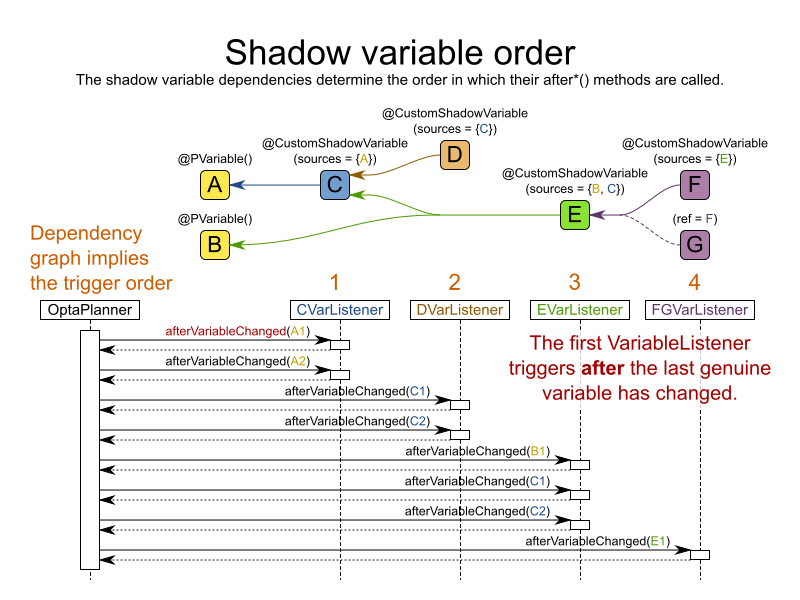
VariableListeners now trigger in a smart order
In advanced use cases with multiple custom shadow variables (or even just one),
the immediate order in which a VariableListener was triggered could drive a developer insane
because (s)he had to deal with intermediate, inconsistent states for which not all of the genuine variables were already changed.
This has been fixed. OptaPlanner now triggers the VariableListener.after*() methods in the order defined by the shadow variable dependency graph.
It guarantees that the first VariableListener triggers after the last genuine variable has changed.
It also guarantees that the second VariableListener triggers after all the first VariableListener calls are done, and so on.
New Benchmarker bluePrints
There are 2 new benchmarker blueprints:
-
EVERY_LOCAL_SEARCH_TYPE
-
EVERY_CONSTRUCTION_HEURISTIC_TYPE_WITH_EVERY_LOCAL_SEARCH_TYPE
It’s now even easier to try out all Local Search algorithms:
<plannerBenchmark>
  <benchmarkDirectory>local/data/cloudbalancing</benchmarkDirectory>
  <inheritedSolverBenchmark>
    ...
  </inheritedSolverBenchmark>
  <solverBenchmarkBluePrint>
    <solverBenchmarkBluePrintType>EVERY_LOCAL_SEARCH_TYPE</solverBenchmarkBluePrintType>
  </solverBenchmarkBluePrint>
</plannerBenchmark>
New example: Investment asset class allocation
To optimize an investment portfolio. See this video. Partially contributed by Satish Irrinki.
Other improvements
-
A bi-directional relationship with a planning variable is now also supported for a non-chained variable.
-
2 shadow variables can now share the same
VariableListenerinstance. -
ValueRangeProvidernow supportslongranges withcreateLongValueRange(from, to)too. -
ValueRangeProvidernow supportsBigIntegerranges withcreateBigIntegerValueRange(from, to)too. -
Improved
Move.toString()methods for more clearer log messages. -
Benchmarker report mentions logging level used. Contributed by Matej Čimbora.
-
Documentation for Android. Contributed by Tomáš David.
-
Benchmarker’s
<solverBenchmark>name now allows non-ASCII characters too (for example Japanese characters). -
An OSGi
features.xmlthat includesoptaplanner-engine -
Drools score calculation now support multiple constraint matches in the consequences part of a rule.
-
More JavaDocs, including package JavaDocs.
-
Various bugs resolved. See our issue tracker.
Upgrade your code to 6.3
The best and easiest way to upgrade to this new version of OptaPlanner is by following the upgrade recipe.
New features in older releases
Read the previous release notes to learn about the new and noteworthy in previous releases.
Latest release
-
Wed 8 December 2021
Paid support and consulting
Want to talk to the experts? Red Hat offers certified binaries with enterprise consulting. Contact optaplanner-info for more information.
Upcoming events
-
Brno, Czech Republic (virtual) - Fri 28 January 2022
- Artificial Intelligence on Quarkus: I love it when an OptaPlan comes together by Geoffrey De Smet
-
Stockholm, Sweden - Mon 7 February 2022
- AI maintenance scheduling with OptaPlanner on Quarkus by Geoffrey De Smet
Latest blog posts
-
Tue 26 October 2021
Radovan Synek
-
Thu 14 October 2021
Walter Medvedeo
-
Tue 12 October 2021
Christopher Chianelli
-
Tue 5 October 2021
-
Wed 15 September 2021
Geoffrey De Smet
-
Thu 19 August 2021
Lukáš Petrovický
-
Mon 26 July 2021
Latest videos
-
AI lesson scheduling on Quarkus with OptaPlanner
Thu 18 November 2021
-
Maintenance scheduling
Fri 12 November 2021
-
Optimized order picking in warehouses and supermarkets
Tue 26 October 2021
-
A modern OO/FP constraint solver
Tue 14 September 2021
-
Business processes task optimization in Kogito
Tue 7 September 2021
-
School timetable optimization
Mon 6 September 2021
-
Schedule incoming calls real-time
Mon 23 August 2021